
1. What is Post-Delivery Market
The Post-Delivery Market allows Balance Responsible Parties (BRPs) to continue trading a nominated position after physical delivery has already taken place. Rather than accepting whatever imbalance the TSO settles a position at, traders can use the window between delivery and final settlement to correct their position, creating new trading opportunities and mitigating unfavourable imbalance costs.
Post-Delivery Market functions as a direct continuation of Intraday continuous trading: when a contract's normal Intraday Continuous gate closes, the Post-Delivery Market for that same contract opens and remains open until the relevant gate closure.
Where it operates
The Post-Delivery Market is currently available in two bidding zones:
- The Netherlands - gate closure at 09:30 CET the day after delivery
- Belgium - gate closure at 13:00 CET the day after delivery
Both markets operate on the same principle: trade your actual, nominated positions against other BRPs before the settlement window closes. Howevder, the deadlines differ, and traders working across both zones should keep the two gate closure times distinct in their workflow.
Why trade in Post-Delivery?
The value of the Post-Delivery Market comes from the gap between when a position is nominated and when it is actually known. Metering data, plant behavior, and forecast errors are often only fully confirmed after the fact, sometimes well after Intraday gate closure. The Post-Delivery Market gives traders one more opportunity to act on that information before it becomes a fixed imbalance cost and adjust positions accordingly.
Transmission system operators (TSOs) activate reserves to maintain the stability of the grid. The Netherlands operates under a dual-pricing balance settlement model with distinct imbalance prices for both balancing directions. For any given imbalance settlement period, the activation of reserves dictates the state of the grid, and thereby the formation of the imbalance price for the respective balancing direction:
- No upwards or downwards regulation
- Only upwards regulation
- Only downwards regulation
- Both upwards and downwards regulation
In the dual-pricing model, it can be roughly stated that if the TSO activates reserves in both directions at different prices, it creates a spread between the upwards and downwards regulation prices. This creates opportunities for market participants to trade Post-Delivery to adjust positions before the settlement window, as the Post-Delivery price may be more favourable than the imbalance price.
Some Example Scenarios:
Forecast correction on a renewables portfolio. A wind asset manager nominates a position based on the latest forecast available before Intraday gate closure. Actual generation over the delivery hour comes in noticeably above forecast, the wind picked up later than any forecast update could capture. Rather than letting the surplus flow through to settlement, the trader sells the excess volume in the Post-Delivery Market against a counterparty who is short for the same period.
Recovering from an unplanned outage. A flexible generation asset comes short before or during a delivery period after the trader has already sold the expected output on Intraday. The shortfall is only confirmed once the outage is logged. The trader uses the Post-Delivery Market to buy back the missing volume from another BRP, rather than leaving the full shortfall to be priced at the imbalance price.
Late demand-side corrections. A supplier's metering data for a delivery hour comes in materially different from the nominated consumption, for example following a large industrial customer's unplanned shutdown mid-period. Since this is only visible once meter reads are processed, the supplier uses the Post-Delivery window to true up the position rather than carry it into settlement.
Cross-portfolio netting. A trading desk running several BRPs or portfolios finds that one portfolio ended up long for a delivery hour and another ended up short, purely due to independent forecast errors on each book. Instead of both positions separately flowing to settlement, the desk nets them off against the market in the Post-Delivery window.
2. The UI: how it works in Nord Pool
The Post-Delivery Market is currently enabled by default for any member that has access to the Netherlands or Belgium bidding zones in Intraday Continuous Market. On the Intraday screen, the Post-Delivery Market appears as a direct continuation of the same contract, marked orange with the PD Prefix. If you cannot see the Post-Delivery Contracts, try enabling it from the Market Types Dropdown on the top right corner of the market view.
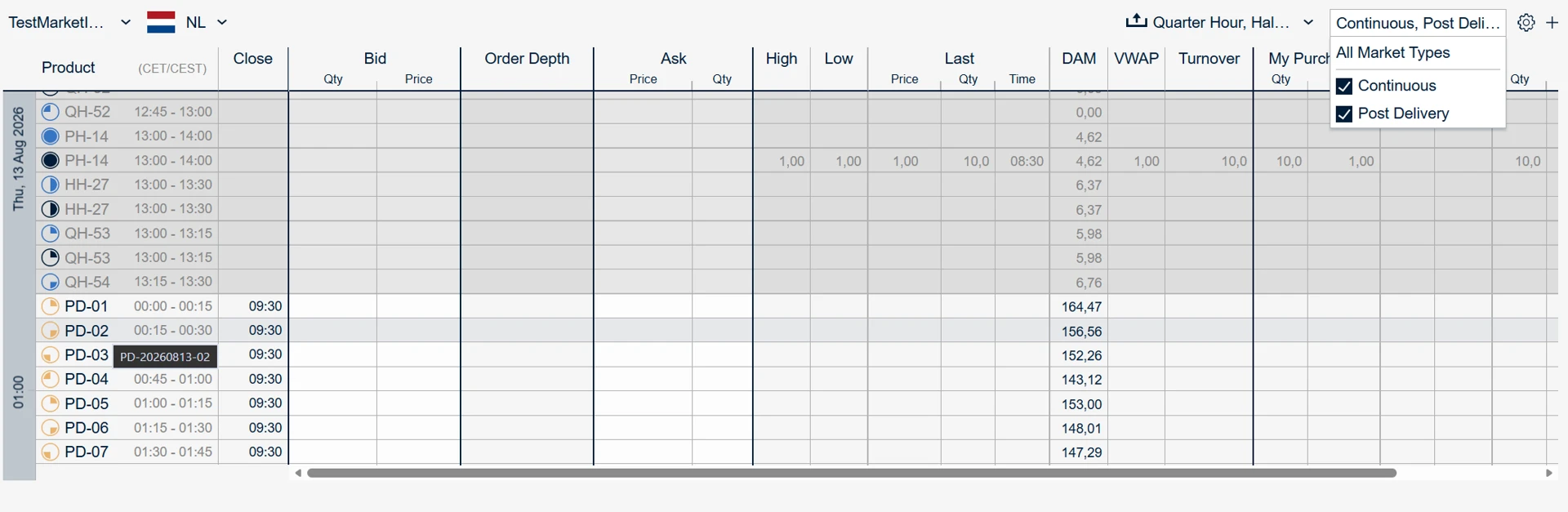
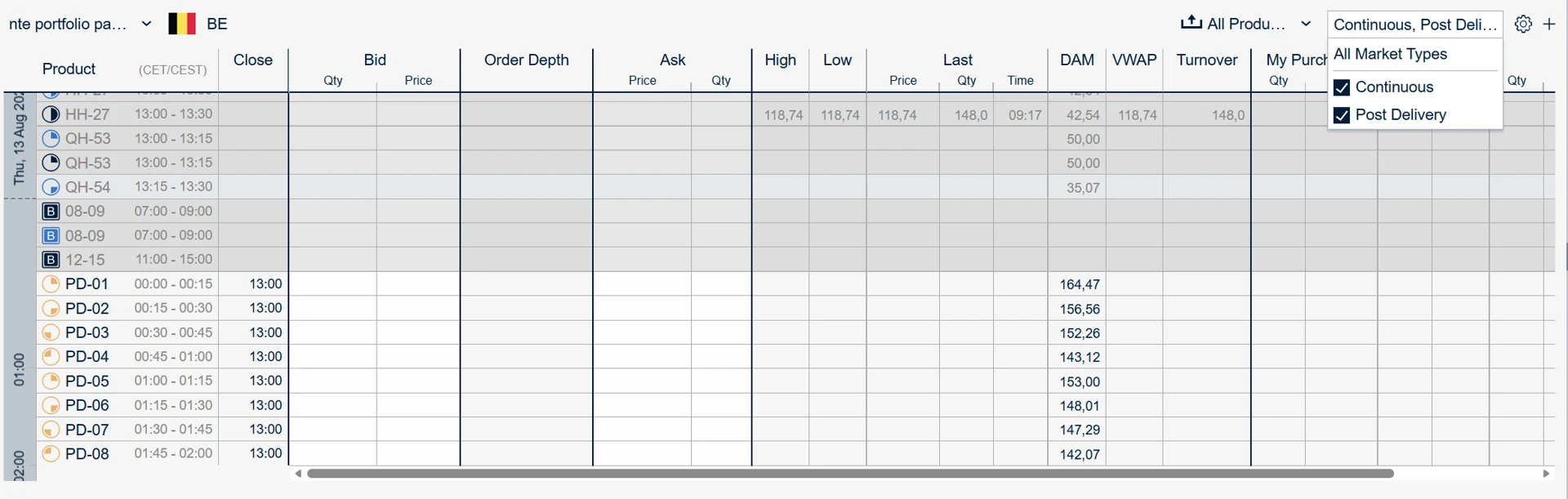
As soon as a contract's Intraday continuous trading closes, the Post-Delivery order book for that contract opens automatically, and it stays open until the relevant gate closure:
- 09:30 CET for Netherlands contracts.
- 13:00 CET for Belgium contracts.
Because the Post-Delivery Market is treated as a continuation of Intraday continuous, the trading experience is deliberately consistent with what you already use: all order types available on Local Intraday continuous are also available in the Post-Delivery Market. There is no separate order type set to learn, and no separate screen to navigate to.
Please note that sending orders with LinkedBasket=true is not available for this market.
API
Post-Delivery Market access is also available through Intraday Continuous Trading API. You can manage your orders, get market information through the same API. For more information, please visit our developer portal.
About Intraday API
Throttling Limits
Post-Delivery Market runs as a local market in the Netherlands and Belgium. This means that API Throttling Limit for Nord Pool’s Local Market is going to be in force when submitting orders. The default throttling limit for local market is:
- 5,000 orders per hour.
- 500 orders per 10 seconds.
Clearing and Settlement
Post-Delivery Market follows Nord Pool’s regular settlement cycle for Intraday Continuous.
How REMIT applies to Post-Delivery?
Post-Delivery Orders and Trades are reported to ACER through REMIT practices. Nord Pool will continue to report these to ACER in line with REMIT requirements.